



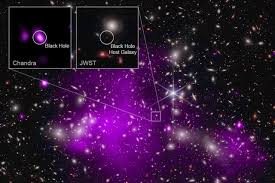
An international team of astronomers has achieved a monumental breakthrough in cosmic history by making the first-ever direct mass measurement of a massive, dormant black hole lurking at the center of a galaxy from the early universe. Utilizing the unparalleled infrared sensitivity of NASA’s James Webb Space Telescope (JWST) in tandem with a rare cosmic phenomenon known as gravitational lensing, scientists managed to peer into the heart of galaxy MRG-M0138, whose light has traveled an astonishing 10 billion years to reach Earth. Weighing in at a mind-boggling six billion times the mass of our Sun, this supermassive black hole is no longer actively “feeding” on surrounding matter or lighting up its cosmic neighborhood, making it incredibly difficult to detect using traditional astronomical methods. To bypass this invisibility, researchers capitalized on a massive foreground cluster of galaxies that acted as a natural magnifying glass, stretching and brightening the distant galaxy’s appearance by roughly 30 times. By observing the collective, high-velocity movements of ancient stars swinging through the dormant monster’s gravitational sphere of influence, the team successfully calculated its exact weight. Previously, this ultra-precise “stellar dynamics” weighing technique could only be utilized for quiet black holes within a relatively close distance of 700 million light-years from Earth. Pushing this capability back to a time when the universe was merely three billion years old fundamentally alters our understanding of cosmic evolution. The discovery provides pivotal evidence that the universe’s most compact, dense galaxies were hotbeds for hyper-rapid black hole growth in the distant past. It also suggests that the immense energy once blasted out by this black hole during its ancient, active “quasar” phase likely cooked or blew away the cold gas reservoirs required to form new stars, prematurely grinding the host galaxy’s growth to a sudden halt. As the scientific community prepares to apply this revolutionary technique to other ancient, silent galaxies via upcoming data from the Euclid satellite and the Nancy Grace Roman Space Telescope, this landmark JWST achievement promises to finally decode the deep-space mystery of how galaxies and their central giants grew up together.